The slab formula
cubic yards = length (ft) × width (ft) × thickness (in) ÷ 324
A 20 × 20 ft slab 4 in thick: 20 × 20 × 4 ÷ 324 = 4.94 cubic yards. With 10 percent extra, 5.43 cubic yards, which you would order as 5½.
For bags, work in cubic feet: 20 × 20 × 0.333 = 133.3 cubic feet. 133.3 ÷ 0.60 = 223 bags of 80 lb, or 133.3 ÷ 0.45 = 297 bags of 60 lb, before waste. At that volume, a ready-mix truck is the practical choice.
Slab size chart
Cubic yards and bags with no waste added. Add your allowance on top.
| Slab | Thickness | Cubic yards | 80 lb bags | 60 lb bags |
|---|---|---|---|---|
| 4 × 4 ft | 4 in | 0.20 | 9 | 12 |
| 10 × 10 ft | 4 in | 1.23 | 56 | 75 |
| 10 × 10 ft | 6 in | 1.85 | 84 | 112 |
| 12 × 12 ft | 4 in | 1.78 | 80 | 107 |
| 12 × 20 ft | 4 in | 2.96 | 134 | 178 |
| 16 × 16 ft | 4 in | 3.16 | 143 | 190 |
| 20 × 20 ft | 4 in | 4.94 | 223 | 297 |
| 20 × 20 ft | 6 in | 7.41 | 334 | 445 |
| 24 × 24 ft | 4 in | 7.11 | 320 | 427 |
| 24 × 24 ft | 6 in | 10.67 | 480 | 640 |
| 30 × 30 ft | 4 in | 11.11 | 500 | 667 |
| 20 × 40 ft | 5 in | 12.35 | 556 | 741 |
Bag counts use typical yields of 0.60 cubic feet per 80 lb bag and 0.45 per 60 lb bag.
Common slab thicknesses
| Slab | Common thickness | Notes |
|---|---|---|
| Patio, walkway | 4 in | On a compacted base |
| Shed floor | 4 in | More for heavy equipment |
| Hot tub pad | 4 to 6 in | Check the tub maker’s requirement when full |
| Driveway | 4 to 6 in | Thicker where trucks or heavy vehicles park |
| Garage floor | 4 to 6 in | Often thickened at the edges |
| Workshop with heavy machines | 6 in or more | Usually engineered |
These are common practice for planning. Local code, soil conditions and loads decide the real figure, so check before you form up.
Extras that add volume
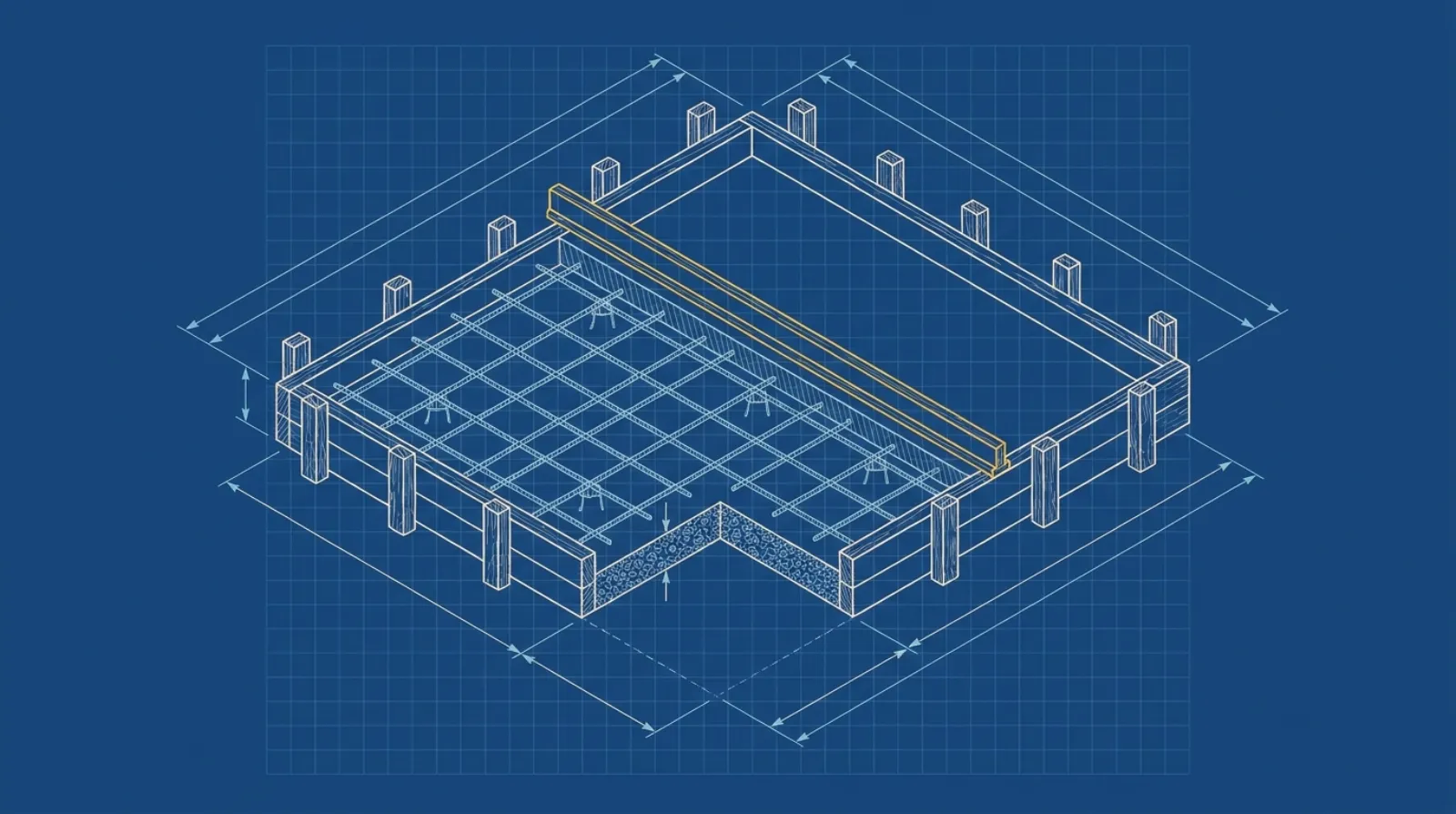
- Thickened edges. Many slabs are deeper around the perimeter. Work out the edge as its own strip: perimeter × edge width × extra depth. A 20 × 20 slab with a 12 in wide edge thickened by 8 in adds 80 × 1 × 0.667 = 53.3 cubic feet, about 2 cubic yards.
- Interior footings or grade beams. Enter each as another section.
- Uneven subgrade. A base that dips half an inch over a large slab adds up quickly: on a 20 × 20 slab, an extra ½ inch is about 0.62 cubic yards.
- Steps or a stoop attached to the slab. See the steps example in how to calculate yards of concrete.
L-shaped, round and odd slabs
Use one section per piece:
- L-shape: two rectangles that do not overlap.
- Round pad: Circle, enter the diameter.
- Angled corner: a rectangle plus a Triangle section.
- Several identical pads: one section with How many set to the count.
The calculator totals every section and applies the waste percentage once.
Ready-mix or bags for a slab
For anything bigger than a small pad, ready-mix is usually the realistic option. A 10 × 10 ft patio is already 56 bags of 80 lb, about 4,500 lb of dry mix to lift and mix, and it has to go in quickly enough that batches blend together. Get a delivered quote and compare it with bag count × bag price using concrete cost per yard, and see the concrete bag calculator for small slabs.
Order with a margin and confirm the quantity with the plant. It is far easier to deal with a little leftover concrete than to stop a pour halfway while a second truck is on its way.
Questions people ask
- How much concrete do I need for a 20 × 20 slab?
- At 4 inches thick, 20 × 20 × 4 ÷ 324 = 4.94 cubic yards. With 10 percent extra, about 5.4 cubic yards. At 6 inches it is 7.41 cubic yards before waste.
- How many bags of concrete for a 10 × 10 slab?
- A 10 × 10 ft slab 4 inches thick is 33.3 cubic feet: 56 bags of 80 lb or 75 bags of 60 lb, before any extra. Add about 10 percent for waste.
- How thick should a concrete slab be?
- 4 inches is common for patios, walks and shed floors; 4 to 6 inches for driveways and garage floors. Heavier loads, poor soil and local code can call for more.
- Does the gravel base count toward the concrete thickness?
- No. Measure the concrete thickness from the top of the compacted base to the top of the forms. The base is a separate layer and a separate order.
- How do I calculate an L-shaped slab?
- Split it into two rectangles that don't overlap and add them. In the calculator, enter each rectangle as its own section.